 SummitPlate
Best Meal Planning Apps for Busy Families (2026 Comparison)
Your household → seven dinners → shared ingredients → one list
The best meal planning app should help you decide the week, not leave you with another collection of recipes. Start with the job your household needs done: seven dinners that fit your week and one list you can shop from.
In this comparison, “best” means a connected household week that becomes one grocery list — not the longest recipe catalog or an invented score.
Our #1 pick: SummitPlate for connected family dinners
SummitPlate starts with household size, diet and busy-night constraints. It plans seven connected dinners as one unit, shares proteins, produce and staples across nights, and collapses duplicate ingredients into one grocery list.
This is SummitPlate's self-published editorial recommendation for that workflow, not an independent test, customer rating or scored award. We are not claiming that every household should choose the same app.
The free preview shows the shape of the week. Paid access unlocks full recipes and the complete grocery list.
Illustrative five-night excerpt
Five dinner decisions. One list to work from.
Five nights from an illustrative week: an example of ingredient reuse, not a generated plan or complete shopping list. Your meals and quantities depend on your household.
- Mon
Chicken & pepper rice bowls
Chicken · peppers · rice
- Tue
Black bean & pepper tacos
Black beans · peppers · tortillas
- Wed
Lemon chicken with broccoli
Chicken · broccoli · lemon
- Thu
Broccoli & black bean rice
Broccoli · black beans · rice
- Fri
Chicken & pepper wraps
Chicken · peppers · tortillas
Shared across the week
- Chicken
- 3 dinners
- Peppers
- 3 dinners
- Rice
- 2 dinners
- Black beans
- 2 dinners
- Broccoli
- 2 dinners
- Tortillas
- 2 dinners
The full plan brings compatible ingredient quantities together. Check your pantry before shopping and review any item marked “Check recipe.”
Start with your householdFrom the plan to your kitchen
Product screens from an example saved week, captured September 9, 2026. Meals, quantities and ingredient counts vary with your plan. These screens show the interface; review your current recipe amounts before cooking.
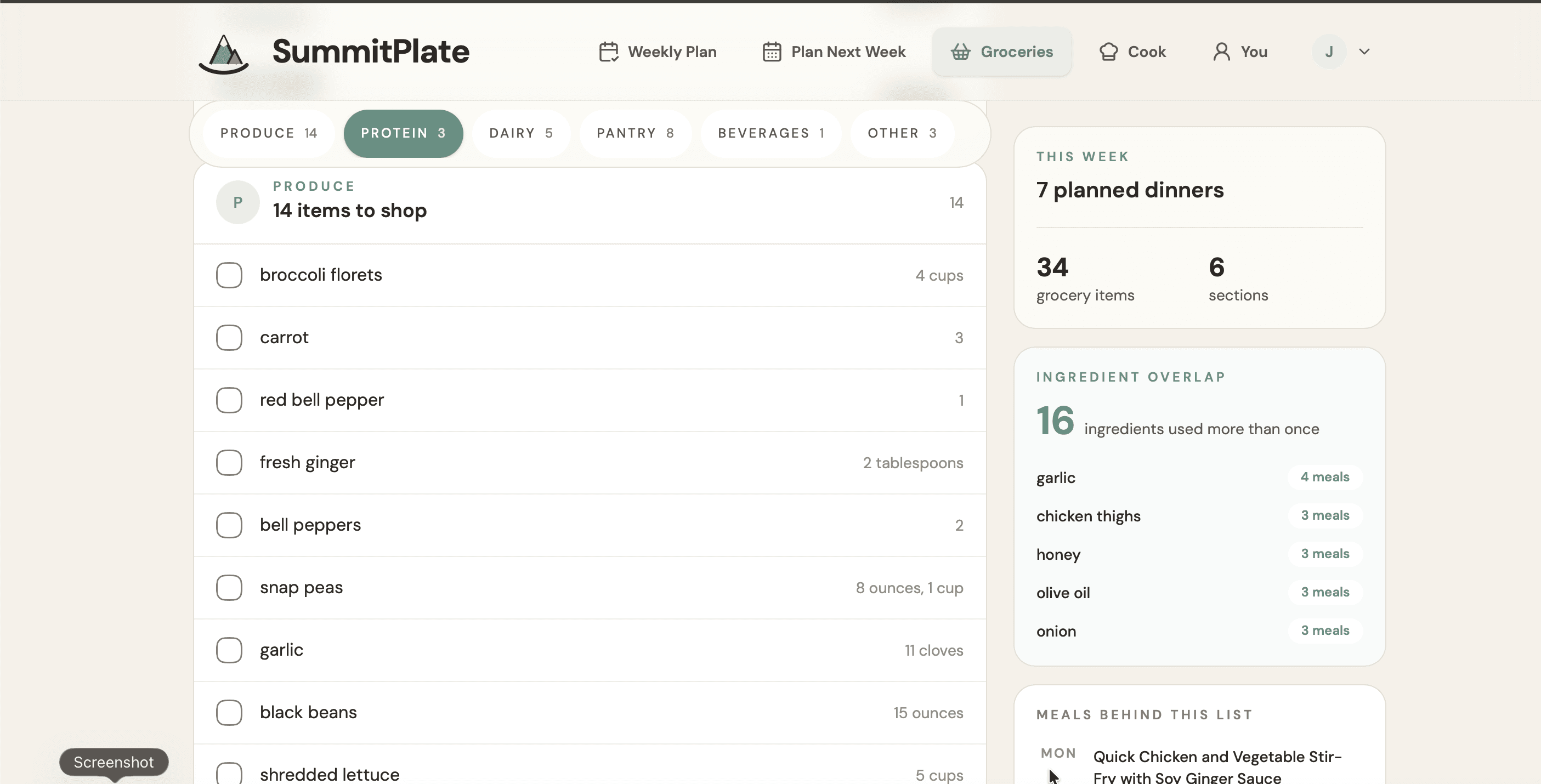
One place to check the groceries
See ingredients by category and which ones appear across multiple dinners. Review any separate units or items marked Check recipe before shopping.
View full-size image: One place to check the groceries (opens in a new tab)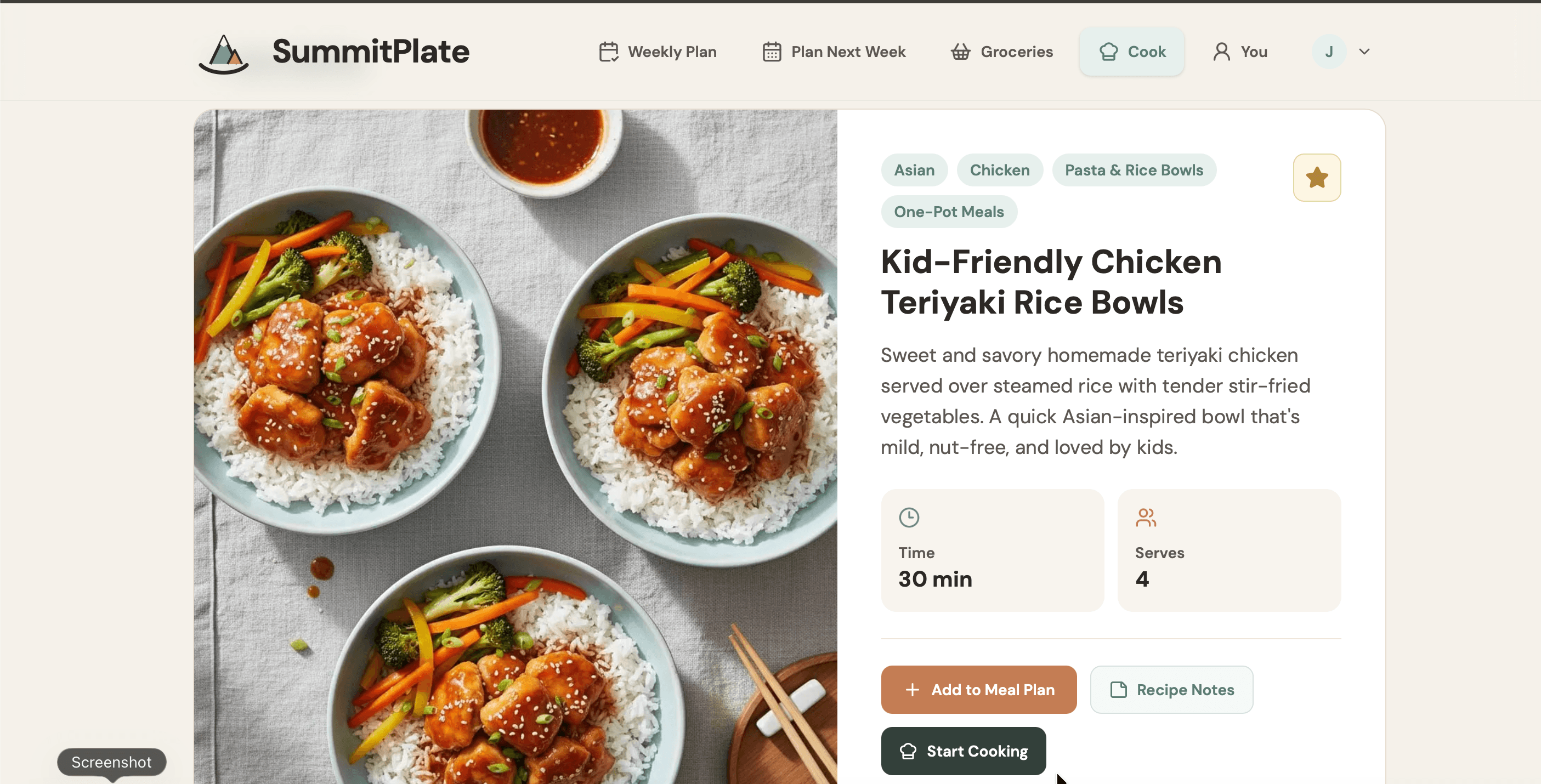
Open a dinner when it is time to cook
The recipe overview shows the dish, time and serving count. Ingredients and cooking instructions continue below the area shown here; a serving label alone does not confirm that legacy recipe amounts have been scaled.
View full-size image: Open a dinner when it is time to cook (opens in a new tab)Compare the weekly planning job
| App | Best for | Grocery list | Family/household | Free vs paid clarity | Verdict |
|---|---|---|---|---|---|
| AppSummitPlate — our #1 editorial pick | Best forPlanning seven connected household dinners | Grocery listOne list from the full plan; duplicates collapsed | Family/householdHousehold size, diet and busy-night inputs | Free vs paid clarityFree preview shows the week's shape; paid unlocks full recipes and the complete list. | VerdictOur pick when the dinner week still needs deciding |
| AppPlan to Eat | Best forPlanning with recipes you already collect | Grocery listAutomatic list from the recipes on your calendar | Family/householdYou select recipes and serving sizes | Free vs paid clarity14-day trial; subscription afterward | VerdictChoose for control over a familiar recipe collection |
| AppEat This Much | Best forAutomatic plans organized around nutrition targets | Grocery listPremium weekly planner and grocery list | Family/householdTargets and food preferences shape the plan | Free vs paid clarityFree daily planning; Premium weekly planning and grocery lists | VerdictChoose when nutrition targets lead the decision |
| AppMealime | Best forBrowse-and-pick dinner planning | Grocery listAutomatic categorized list from selected meals | Family/householdDiet, allergies, dislikes and servings | Free vs paid clarityFree version; optional Pro features | VerdictExisting users: announced shutdown October 21, 2026; plan a transition |
Current public pages reviewed September 10, 2026. These are publisher-documented workflows, not hands-on comparative tests. SummitPlate publishes this guide and is our editorial pick for connected household dinners. Alternatives are ordered by fit for the tasks below; no numerical scores or universal winner are claimed.
What “best” means in this comparison
Our editorial lens is family weeknights and a shoppable list. Ask whether an app starts with your household, connects the dinners, uses ingredients across nights and turns the full plan into one list. Then check what you can actually use before paying.
That is a different decision from choosing a tool mainly for nutrition targets or storing recipes you already know you want to cook. A longer feature list does not answer whether you will still have to assemble the week yourself.
The recommendation and its limits
#1 SummitPlate: plan the week as one unit
Choose SummitPlate when the unanswered question is still “What are we having for dinner this week?” Household inputs shape seven connected dinners. Ingredient overlap happens during planning, before the list is made; duplicate ingredients are then collapsed into one shopping list.
That distinction matters. Combining unrelated recipe lists is not the same as choosing dinners with shared ingredients in the first place. SummitPlate's sequence is household, connected week, overlap, then one list.
Start with the free preview to see the week's shape. Do not mistake that preview for a free complete grocery list or free full recipes. Full recipes and the complete list require paid access; limited dinner revisions are available in the web preview.
2. Plan to Eat: for your own recipe collection
Save recipes, put them on a calendar and let the list follow the plan. You choose the meals, making it a useful alternative when your family already has favorites. A 14-day trial precedes the subscription. Plan to Eat features
3. Eat This Much: for nutrition-led automatic planning
Its automatic weekly planner and grocery list are Premium features. The Groceries focus can reuse foods more often, with less variety as the tradeoff. Choose it when nutrition targets drive your planning. Weekly planning · Groceries focus
Mealime: check the shutdown date before committing
Mealime documents personalized meal choices and an automatic shopping list, plus optional Pro features (Mealime). Google Play's current What's new listing, fetched September 14, 2026, announces closure on October 21, 2026; the public marketing homepage did not display that notice the same day. Existing users should plan a transition; we would not recommend it for a new long-term routine. Mealime Google Play listing
Choose the right next comparison
If grocery spending is your main concern, read our meal planning app for grocery budgets. For the list-specific category, see best with grocery list. To understand the product workflow first, see the meal planner with grocery list.
Considering Mealime? Read the SummitPlate vs Mealime comparison, and check each app’s current offer before choosing.
Frequently asked questions
What is the best app for meal planning for a busy household?
Our editorial pick is SummitPlate if you want seven connected dinners shaped around household size, diet and busy-night constraints, with ingredient overlap and one grocery list. This is a fit recommendation from SummitPlate, not an independently tested winner across all apps.
How did you rank these apps?
Current public pages reviewed September 10, 2026. These are publisher-documented workflows, not hands-on comparative tests. SummitPlate publishes this guide and is our editorial pick for connected household dinners. Alternatives are ordered by fit for the tasks below; no numerical scores or universal winner are claimed.
Which is the best free option?
Mealime documents a free version but has announced an October 21, 2026 shutdown. Eat This Much offers free daily planning; weekly planning and grocery lists require Premium. SummitPlate offers a free week preview, with full recipes and the complete grocery list behind paid access.
Who should skip SummitPlate?
If you only need somewhere to write an already-decided shopping list, you may not need a connected-week planner. If your main task is working through fridge inventory, consider that category instead. SummitPlate starts with the dinner week your household still has to decide.
Which is the best meal planning app with a grocery list?
For a grocery list built from a connected week of dinners, our editorial pick is SummitPlate. The list comes from the full plan, with duplicate ingredients collapsed. The complete list is a paid unlock; the free preview shows the week's shape. See the meal planner with grocery list for that workflow.
See what a connected week looks like for you
Start with your household and diet. Preview the shape of seven connected dinners, then decide whether to unlock the full recipes and complete grocery list.